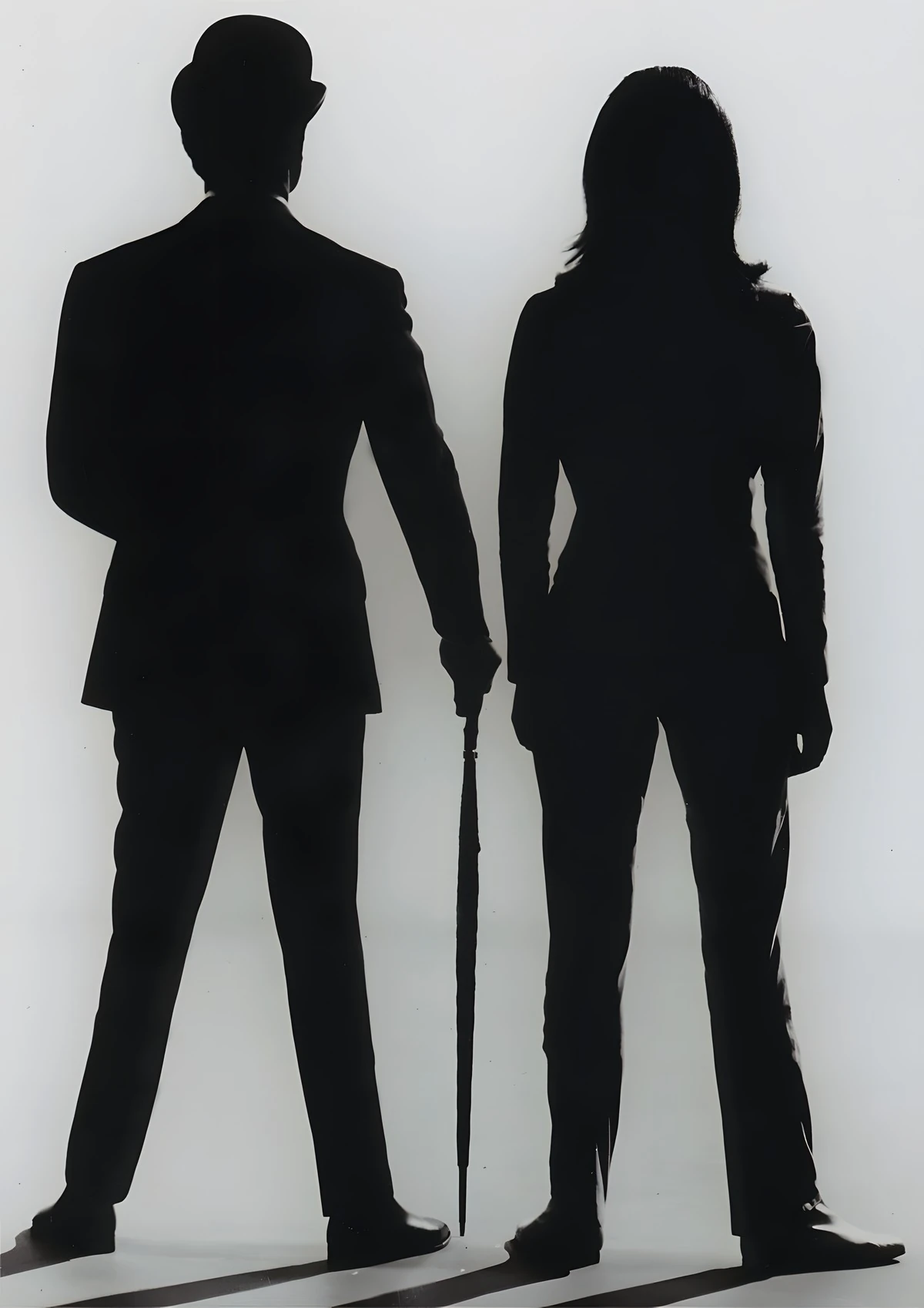
The Avengers
A British Spy Series Takes an Unexpected Route to Radio
The Avengers ran on British television from January 7, 1961 to April 21, 1969, becoming one of the more unusual exports of that era — unusual not because it crossed the Atlantic, as it did, but because its most complete radio incarnation was born in Johannesburg. The television series, produced by ABC Weekend TV for the ITV network, followed the debonair secret agent John Steed through eight years of high espionage adventures. It gave British television some of its most iconic pairings: Steed alongside Cathy Gale played by Honor Blackman, then Emma Peel played by Diana Rigg, and finally Tara King played by Linda Thorson. By the time the TV run ended, the show had logged 161 episodes across six seasons and become one of the first British series to air in prime time on an American network.
The radio version, however, took shape in South Africa. Sonovision Ltd., a Johannesburg production company owned by Dave Gooden, secured the rights and recorded the series at Sonovision Studios. The broadcasts aired on Springbok Radio, the English-language commercial service of the South African Broadcasting Corporation. The series ran from December 6, 1971 through December 28, 1973 — placing it firmly in the early-to-mid 1970s, well after the television original had concluded.
Why South Africa, and Why Radio
The answer to both questions is the same: South Africa had no national television service until 1976. For most of the country's English-speaking audience, radio was simply how they experienced everything. That context made Springbok Radio a natural home for a prestige dramatic serial, and it made The Avengers a strong candidate for adaptation — the show already had an enormous following, and its combination of wit, intrigue, and stylish plotting translated well to the audio format.
Episodes ran approximately fifteen minutes including advertisements and broadcast Monday through Friday at 7:15 pm, fitting neatly into an evening schedule. The series sponsor was Lever Brothers, credited at the start of each episode as "the makers of Cold Water Omo." The production approach shifted somewhat over the run: Tony Jay adapted and directed the first six months of episodes, breaking stories into five-episode serials. Dennis Folbigge then took over for the remainder of the run, with serials ranging between five and eight episodes in length. Both men were working from original television scripts drawn from the Emma Peel and Tara King TV seasons, though the radio version replaced Tara King entirely — Emma Peel remained Steed's partner throughout all of the radio episodes.
The Cast
Donald Monat played John Steed in the radio series. Born in London, he moved to South Africa with his family at age eleven, continued his schooling and university education there, and won his first acting role in Johannesburg at sixteen. From there he built a steady career as a radio drama performer, eventually becoming a multifaceted presence in the industry as an actor, writer, producer, and director. He later produced comedy revues on the London stage and worked as a voice artist in the United States. Monat was well suited to Steed's particular register: the character required a certain dry authority, a quality of contained amusement that the role demanded without tipping into parody.
Diane Appleby played Emma Peel. Like Monat, she was a British expatriate working in South Africa, which gave the central pairing a credible transatlantic quality that matched the tone of the original television series. Hugh Rouse, already well known to South African audiences as a radio newscaster, provided the tongue-in-cheek narration that framed each episode. That narration was part of what gave the radio version its particular flavor — a knowing wink at the audience that kept the show light even when the plots turned sinister.
How the Stories Were Structured
The multi-part serial format was central to how The Avengers worked on radio. Rather than telling a complete story in a single fifteen-minute episode, the production broke each case across several installments — giving plots room to develop and giving the audience a reason to tune in every evening. The catalog reflects this structure clearly. "A Case of Interrogation" runs to at least seven parts; "A Deadly Gift" spans at least five. Both are representative of the kind of layered, espionage-driven storytelling that defined the series.
The show leaned into what had always made The Avengers distinctive as a television property: plots that favored ingenuity over brute force, a central duo whose partnership carried real chemistry, and a consistently high-espionage atmosphere that one description characterized as a prototype of the James Bond genre. The radio adaptation preserved those qualities by working directly from the original TV scripts rather than creating original material, which helped maintain both the tone and the structural sophistication of the source.
What Survives
The question of survival is the most complicated part of this show's history. It is believed that between sixty and eighty serials were produced over the roughly eighteen months the series ran. The reason so few made it to the present has nothing to do with fire or neglect in the conventional sense — it has to do with economics. Blank recording tape was expensive, and the SABC's standard policy was to air programs once and then record over the tapes. Most of the series was simply erased in the ordinary course of operations.
As of the early 2000s, only nineteen serials were known to exist in their entirety, and all of them come from the Folbigge era. The Jay period — the first six months of the run — is almost entirely gone. The 121 episodes in this catalog represent what has been preserved from a production that was considerably larger than what survives. The show's reputation among those who have heard it rests on the quality that comes through even in that partial record: strong sound production from the Sonovision Studios sessions, a well-chosen cast, and plots that held their shape across multiple episodes.
The radio series is listed among the recognized spin-offs of the television original, alongside a stage production and the later television sequel The New Avengers — a small but meaningful acknowledgment of what the Johannesburg production accomplished in the years before South African television existed.